
What Is Ayurveda? A Beginner's Guide to the Principles of Ayurvedic Medicine
Ayurveda is a holistic medical system that has been practised for over 5,000 years. Based on the principles of the five elements, the three doshas (Vata, Pitta and Kapha), and the philosophy of living in harmony with nature, Ayurveda aims to prevent disease by restoring balance within the body and mind. Understanding concepts such as Prakriti, Vikriti, Agni, Ama and the six tastes provides the foundation for making personalised dietary and lifestyle choices that support long-term health and wellbeing.
Cristina Tosta
1/6/20263 min read
Ayurveda, one of the world’s oldest medical systems, has roots that stretch back over 5,000 years. This ancient practice has stood the test of time and continues to be practiced in India and around the globe. Ayurveda is regarded as an ancient medical system that complements the theories found in the Atharvaveda. According to Hindu mythology, the god Brahma, who is believed to have created the universe, imparted the knowledge of Ayurveda to the physicians of the gods. This knowledge was then passed down to sages, who in turn shared their wisdom with future generations.
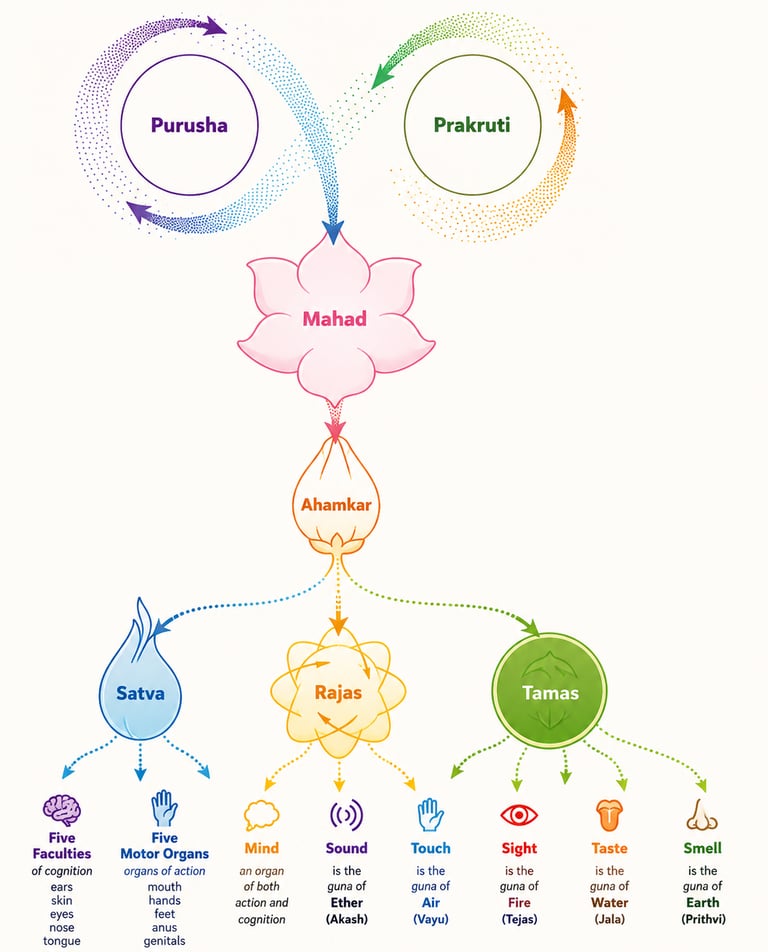
Ayurvedic literature is based on the Samkhya philosophy, which is considered the one of oldest technical schools of India Philosophy. Samkhya philosophy emphasises intellect and reasoning and is characterised by its dualistic nature. It is defined by two main concepts: Purusa, which represents pure consciousness(spirit), and Prakrti the matter (unmanifest material), which creates three fundamental qualities known as gunas. These qualities are intelligibility (sattva), activity (rajas), and inertia (tamas). The purpose of Samkhya is to attain radical liberation (moksha) from frustration and the cycle of rebirth. It is believed the universe and each individual are composed of five elements: air, fire, water, earth, and space (or ether).
Different combinations and proportions of these five elements form the three energies, or doshas, in Sanskrit: Vata (air and space) associated with movement, Pitta (fire and water) associated with digestion and metabolic system in the body , and Kapha (water and earth) associated with body’s structure. The Tridosha theory of Ayurveda explains that there are three fundamental principles or forces which govern the physiology of each individual.
Each individual's unique composition of the five elements is determined by the time of conception and remains the same for their entire life (prakruti). The concept of prakruti plays a central role in the practice of Ayurveda. It is used to interpret and manage health and disease states.
Ayurveda believes that diseases arise from changes in the quality, quantity, composition, or balance of the five elements. When the doshas become unbalanced or vitiated (vikruti), they can cause toxins, known as amas, to circulate freely in the body. The primary goal of Ayurveda is to restore balance through a combination of practices, including a balanced diet, herbal remedies, massage, detoxification, yoga, and meditation.
The primary principle of Ayurveda is to achieve balance through managing the 20 attributes of the doshas, known as gunas. The idea behind Ayurveda treatments and food preparation is based on the understanding and application of these attributes, which suggest that "like increases like. Charaka classified the gunas into 10 opposing pairs, which function together as male and female energies (e.g.:light vs heavy / oily vs dry). An Ayurvedic practitioner would use the opposite gunas to achieve a state of balance in an individual.
Ayurveda believes there are six tastes (rasas), each formed by a combination of the five elements. They are also associated with specific organs in the body, and emotions. The six rasas: sweet (earth+water) related to the thyroid and upper lungs;sour (earth+fire), lungs; salty (water+fire), kidney; pungent (air+fire), stomach and heart; bitter (air+space), pancreas, liver and spleen; astringent (air+earth), colon. Psychological action of the six tastes: the elements of sweet ‘unfolds the love divine’. Sour taste brings sharpness to the mind. Salty taste increases confidence and courage. Pungent taste promotes more self-consciousness and self-awareness.Astringent taste supports a collected and organised mind
This describes the principles of Ayurveda for promoting a long, disease-free life, supported by a strong agni which governs digestion, absorption, and food assimilation. if agni is in optimal condition the individual will experience a strong and healthy immune system (sama agni). And the opposite will result in deterioration of the health state. When vata dosha is vitiated the individual experiences an irregular metabolism, with irregular appetite and digestion (vishama agni). Vitiated Pitta (tikshna agni) experiences hypermetabolism, eating food frequently and in large quantities. And vitiated kapha (manda agni) experiences slow metabolism and they tend not to digest food properly. The agni is responsible for transforming food into absorbable substances (ahara) that can nourish the body tissues known as dhatus. There are seven bodily tissues according to ayurveda.
In Ayurveda, food is regarded as a form of medicine that heals both the body and mind. The Ayurvedic "golden rules" for strengthening agni and improving overall well-being includes eating only when the body signals a need, incorporating all six tastes in each meal, avoiding distractions while eating, avoid incompatible food combinations, refraining from eating under stress or strong emotions, consuming food in silence, and waiting until the previous meal is fully digested before eating again.
If you're feeling out of balance or would simply like to learn more about Ayurveda, I invite you to book a Complimentary Discovery Call. It's an opportunity for us to get to know each other, discuss your health goals, and explore how I can support you.
I hope you enjoy it.
With Love,
Cristina Tosta
Simply Balanced Holistic Care
Figure 1 - Figure 1 - Samkhya Philosophy of Creation. Lad (1984. p 17). Design recreated by AI
Simply Balanced Holistic Care
4th Floor, Silverstream House. 45 Fitzroy Street, Fitzrovia. London. UK W1T 6EB


Ayurveda is a complementary medicine and does not replace medical diagnosis or treatment. Always consult your GP for medical concerns.
Cristina Tosta is a certified Ayurvedic Practitioner and member of The Complementary Medical Association (CMA)